
Learning Through Play

Week 1 – The Research Behind Play-Based Learning
Play is not separate from learning in the early years—it is one of the most powerful ways young children explore, experiment and make sense of the world around them. Through purposeful play, children develop language, problem-solving, creativity, self-regulation and social skills while building important knowledge and understanding. In this session, we’ll explore the research behind play-based learning and consider how practitioners can create the conditions for rich, meaningful play that supports every area of children’s development.
Week 2 – Planning Purposeful Provision
Purposeful provision is carefully designed to give children meaningful opportunities to explore, practise and extend their learning through play. Rather than simply providing activities to keep children busy, effective provision reflects children’s developmental needs, interests and the knowledge and skills practitioners want them to develop. In this session, we’ll explore how thoughtful planning can create engaging, flexible environments that promote independence, curiosity and sustained learning throughout the day.

Week 3 – Continuous Provision That Drives Learning
Effective continuous provision is more than simply having resources available—it is carefully designed to promote purposeful play, independence and progression in learning. When areas of provision are thoughtfully planned and regularly refined, children can revisit, practise and deepen important knowledge and skills throughout the day. In this session, we’ll explore how practitioners can ensure continuous provision has clear learning potential while still giving children the freedom to explore, create and lead their own play.

Week 4 – The Adult Role in Play
Adults play a crucial role in enriching children’s play—but effective involvement is about knowing when to join, when to extend and when to step back. Through careful observation, thoughtful interaction and well-timed support, practitioners can introduce new language, deepen thinking and help children develop their ideas without taking over. In this session, we’ll explore how adults can sensitively enhance play while protecting children’s independence, creativity and ownership of their learning.

Week 5 – Challenge Without Worksheets
Challenge in the early years doesn't need to come from worksheets or formal tasks—it can be woven naturally into purposeful play, provision and high-quality interactions. By asking thoughtful questions, introducing problems, adapting resources and encouraging children to explore their ideas, practitioners can deepen learning while maintaining curiosity and engagement. In this session, we'll explore practical ways to provide meaningful challenge that develops thinking, independence and problem-solving while keeping play at the heart of learning.
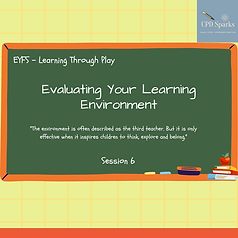
Week 6 – Evaluating Your Learning Environment
An effective early years learning environment should continually evolve in response to children’s needs, interests and learning. Taking time to observe how children use the provision can help practitioners identify what is working well, where learning opportunities may be limited and what small changes could make the greatest difference. In this final session, we’ll reflect on the principles explored throughout the series and consider how purposeful evaluation can ensure the environment continues to promote rich play, independence, challenge and meaningful learning.